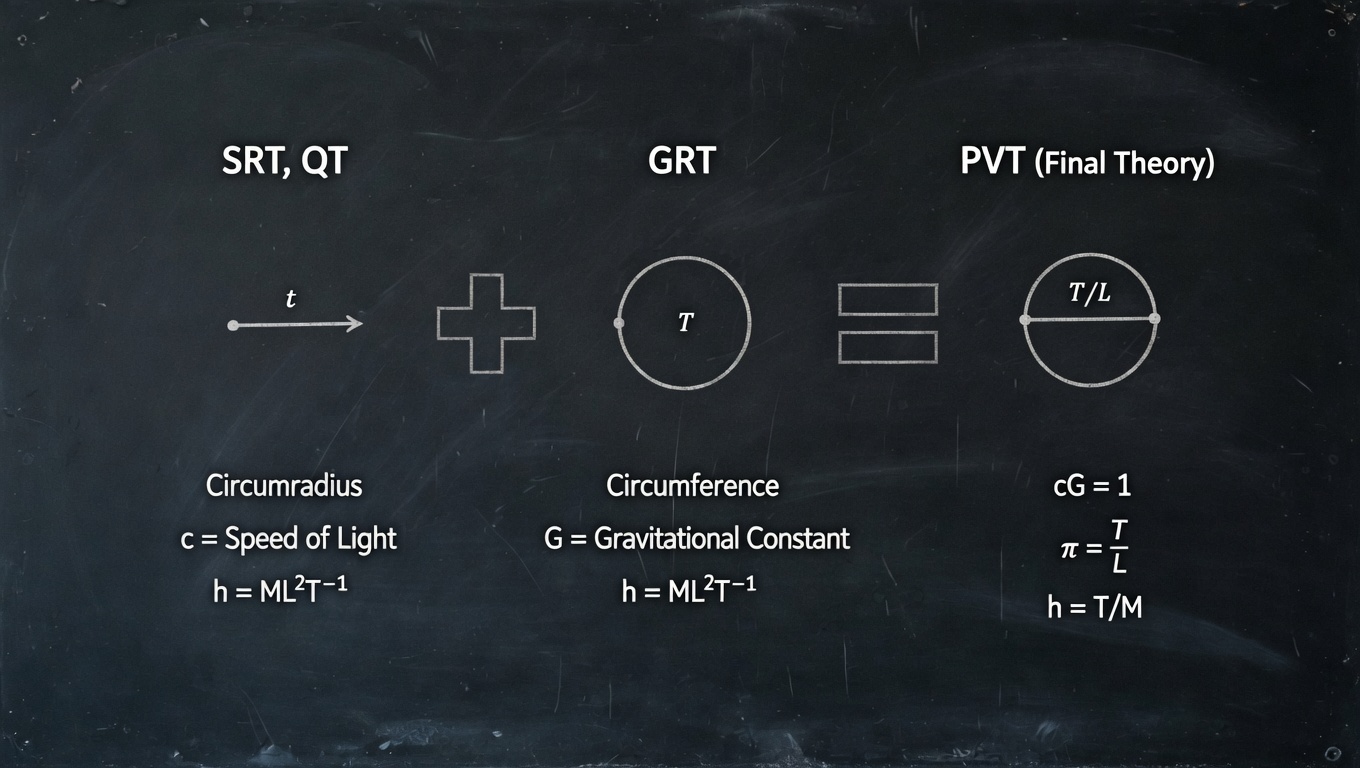
Question: You have been developing the Panvitalistic Theory (PVT) for several years. A question that often comes up is whether it represents a “final theory” or “world formula.” How do you view this?
Manfred U. E. Pohl: I understand why people ask this question, but I prefer not to describe the PVT as a finished “final theory.” What we are pursuing is a fundamental correction of the foundations of physics — a return to clarity in how we understand measurement and time. Once this correction is made, many long-standing incompatibilities begin to dissolve naturally. The theory is still developing, but the direction is clear.
Question: What is the core correction you are referring to?
Manfred U. E. Pohl: Modern physics has treated π as a dimensionless number — length divided by length. This seemingly small convention has had major consequences. It effectively conceals time within the definition of space and turns a dimensioned relationship (π ≡ T/L) into a pure number. As a result, time appears as an external parameter, independent of space. This hidden assumption creates deep tensions between quantum theory and general relativity.
The Panvitalistic Theory restores π to its proper status as a dimensioned quantity. Time is no longer external; it becomes internal angular curvature within volumes. This single shift changes the entire geometric foundation of physics.
Question: You often compare the PVT with other approaches such as string theory or loop quantum gravity. What sets it apart?
Manfred U. E. Pohl: Most current unification programs try to solve the problems of physics by adding new structures — extra dimensions, new symmetries, or new dynamical laws. The Panvitalistic Theory follows the opposite strategy: it attempts to remove unnecessary assumptions.
Instead of adding complexity, we ask: What remains if we consistently treat measurement as the rational comparison of real volumes under the condition of volume invariance (δV = 0)? What happens if we accept that time must be internal rather than external?
The result is a framework in which gravity, electromagnetism, and quantum behavior emerge as different aspects of one and the same geometric structure.
Question: One of the most striking results is the derivation of the numerical value of the speed of light c from the rotation of the Earth without free parameters. Why is this so significant?
Manfred U. E. Pohl: This is one of the strongest arguments for the Panvitalistic Theory. Physics must ultimately be able to explain why the speed of light has the numerical value it has. Since the meter and the second are both defined through the geometry and rotation of the Earth, the value of c cannot be arbitrary — it must be derivable from Earth’s geometry.
In the Panvitalistic framework, the constants c and G are not independent. Their product is fixed by geometry (cG = 1 in natural units). When this relation is expressed using the actual rotational parameters of the Earth, the observed numerical value of c emerges without any free parameters. To my knowledge, no other current theory achieves this. This suggests that what we call “fundamental constants” may in reality be geometric relations that have been obscured by our conventional treatment of dimensions.
Question: Where does the theory currently stand?
Manfred U. E. Pohl: The axiomatic foundation is solid, and we have shown how several deep problems can be reinterpreted in a consistent way. The dynamical formalism is still under development. What we have today is a coherent starting point — a new foundation rather than a completed building. There is still important work ahead, particularly in deriving precise, testable predictions.
Question: What would you say is the most compelling reason to take the Panvitalistic Theory seriously?
Manfred U. E. Pohl: Its combination of radical simplicity and internal consistency. By starting with very few assumptions and consistently applying the principle that measurement must be rational and time must be internal, we arrive at a framework that resolves several long-standing incompatibilities without introducing new mysteries. Whether this path will ultimately prove correct remains to be seen — but it is, in my view, one of the most promising directions currently available.